SPORE application layer — design
The one rule this document is built on: nothing here touches relays. Every feature below is a payload convention plus endpoint state — never a change to what a relay must understand.
That is what keeps a 200-byte LoRa packet, a QR code, or a human reading armor aloud a first-class peer: a relay parses the fixed header, dedups, stores and forwards, and nothing else. A feature requiring relay support would have to be rolled out to every medium in lockstep.
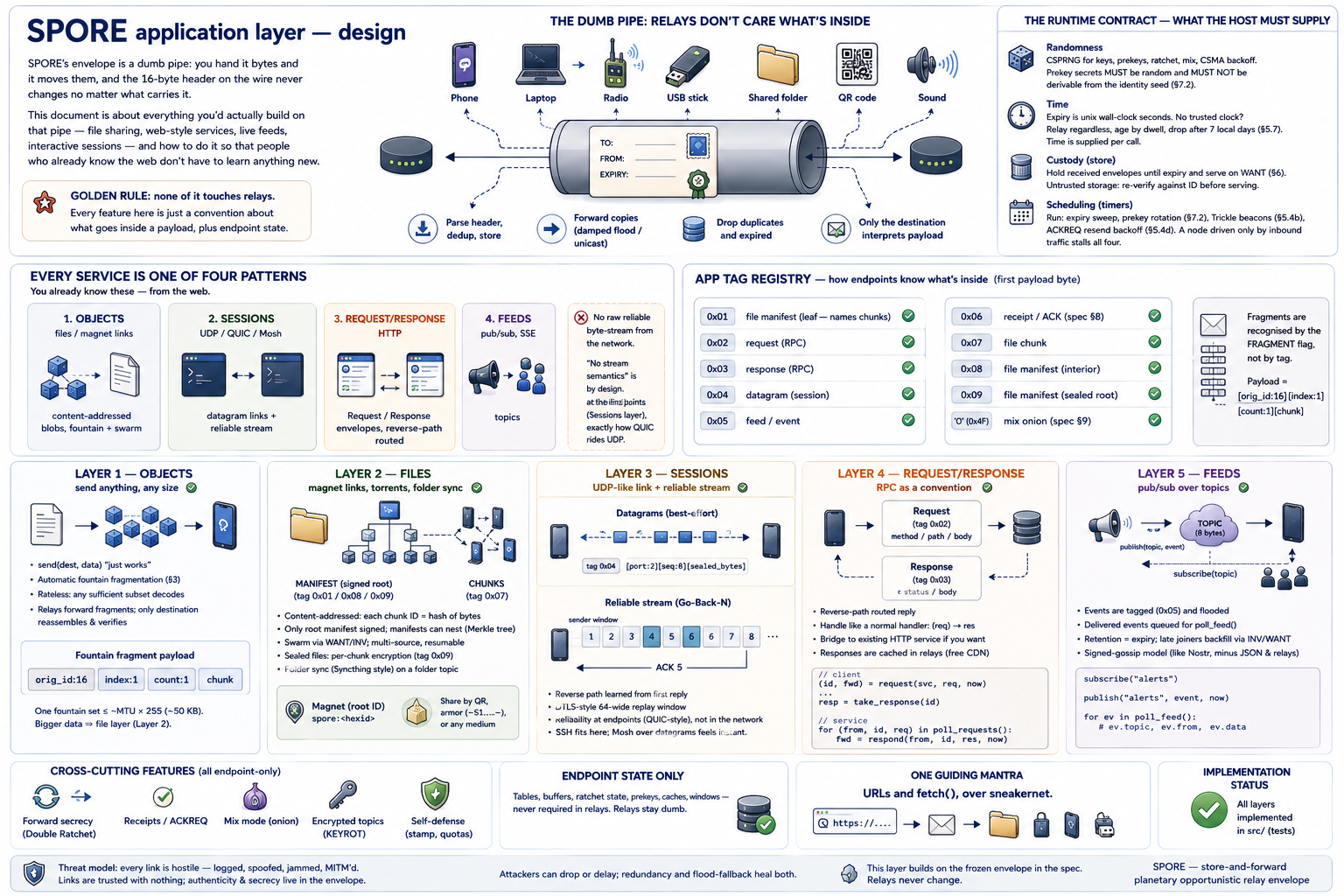
Poster summary, for a quick visual overview — full size. The text on this page is the living source; the poster can lag it.
So the application layer has exactly two ingredients:
- payload conventions — bytes the destination knows how to interpret;
- endpoint state — tables and buffers kept by sender and receiver.
The wire format itself is Spec; it is frozen, and nothing here changes it.
This document has two parts. Part 1 is the application layer — what you build on the envelope. Part 2 is where the core runs and what a host owes it. They are different concerns and are kept apart below.
Part 1 — the application layer
Every service is one of four patterns
Every service maps onto one of four patterns, each already a mechanism or a payload convention. Distinct from the five medium shapes a bridge binds to, below.
Deep dive: the four service patterns and their web analogues
| Pattern | Web analogue | SPORE mechanism | State |
|---|---|---|---|
| Objects | files / magnet links | content-addressed blobs, fountain + swarm | ✅ implemented |
| Sessions | UDP / QUIC / Mosh | datagram links + reliable stream | ✅ implemented |
| Request/response | HTTP | Request/Response envelopes, reverse-path routed |
✅ implemented |
| Feeds | pub/sub, SSE | topics | ✅ implemented |
Note what is deliberately absent: a raw reliable byte-stream offered by the network. The spec lists "no stream semantics" as a feature, because a stream assumes a live, low-latency, bidirectional path — the one thing an opportunistic network can't promise. Reliability still exists, but as an endpoint concern (the Sessions layer), exactly the way QUIC builds reliability on top of UDP without the network knowing.
How endpoints tell payloads apart: the app tag
The frozen header has no port or content-type field. The first payload byte is the app tag, read only by the destination.
Deep dive: the tag registry
| Tag | Meaning | Status |
|---|---|---|
0x01 |
file manifest (leaf — names chunks) | ✅ implemented |
0x02 |
request (RPC) | ✅ implemented |
0x03 |
response (RPC) | ✅ implemented |
0x04 |
datagram (session) | ✅ implemented |
0x05 |
feed/event | ✅ implemented |
0x06 |
receipt/ACK (spec §8) | ✅ implemented |
0x07 |
file chunk | ✅ implemented |
0x08 |
file manifest (interior — names manifests) | ✅ implemented |
0x09 |
file manifest (sealed root — per-chunk encryption) | ✅ implemented |
'O' (0x4F) |
mix onion (spec §9) | ✅ implemented |
Fragments are the one exception: they're recognised by the FRAGMENT header flag,
not a tag, and their payload is [orig_id:16][index:1][count:1][chunk]. The chunk
they carry is a slice of an ordinary, already-tagged inner envelope, so tags and
fragmentation compose cleanly.
Layer 1 — objects: send anything, any size ✅ implemented
send(dest, data) takes any size. Under the MTU it is one envelope; over it,
fountain-fragmented and reassembled by the destination, signature-checked before
the app sees it.
Deep dive: fountain coding and relay behaviour
Node::send(dest, data, now) builds and signs one inner envelope. If its wire form
fits Node::mtu it ships as-is; otherwise it's fountain-fragmented (§3):
- Rateless push: the sender can mint endless distinct repair chunks, so the object decodes from any sufficient subset — simplex radio, CW, and paper tape work with no back-channel at all.
- Relays stay dumb: each fragment is an ordinary flooded envelope with its own ID. A relay forwards fragments but never buffers or reassembles an object that isn't addressed to it — only the destination reassembles.
- Cap: one fountain set is ≤ ~`mtu`×255 (≈ 50 KB at defaults). Larger data is the file layer's job (below), where a tree of manifests carries any size.
Implemented in src/lib.rs (Node::send, Fountain, the ingest reassembly
path) and covered by tests for single-envelope sends, large-object
fragment/reassembly, and relay-forwards-without-reassembling.
Layer 2 — files: magnet links, torrents, and folder sync ✅ implemented
A manifest is a signed envelope naming a file's size and its chunks' content IDs. Its own ID is the shareable magnet. Chunks are fetched from whoever has them and each verifies itself on arrival. The same machinery over a folder is folder sync.
Deep dive: content-addressed chunks, swarming, and folders
A file is split into chunks; each chunk is an ordinary envelope
[0x07][file_id:16][index:4][bytes], so it has its own content ID (the hash of its
bytes). The manifest is a signed envelope listing those chunk IDs in order:
manifest = SIGNED [0x01][file_id:16][chunk_size:4][count:4][total_len:8][name][chunk_id:16 × count]
The manifest's own 16-byte ID is the magnet — shareable as spore:<hexid>, as
~S1.…~ armor, or as a QR.
Manifest trees. A manifest is one envelope, so a single one can only name so many chunks — about 93 KB of file at a 1400-byte MTU. Past that the chunk IDs are grouped under interior manifests, and those grouped again, until what remains fits the signed root. An interior node is the same object one level up:
interior = UNSIGNED [0x08][depth:1][file_id:16][chunk_size:4][count:4][total_len:8][name_len:2][id:16 × count]
At depth == 0 the IDs name chunks; at depth > 0 they name manifests of
depth - 1. Capacity multiplies by the interior fan-out (~84) per level, to a
cap of MAX_DEPTH = 4:
| depth | capacity at MTU 1400 |
|---|---|
| 0 (one manifest) | 94 KB |
| 1 | 8.1 MB |
| 2 | 679 MB |
| 3 | 57 GB |
| 4 | 4.8 TB |
A file that fits one manifest still encodes exactly as it did before trees
existed — same 0x01 tag, same bytes — so nothing that already works changes.
- Integrity is free. The root is signed, so its ID list is authentic; and every ID below it — chunk or sub-manifest alike — is the hash of the bytes it names. A node counts a part as present only when its store holds an envelope whose ID matches the one its parent named, so a forged or corrupt part simply never matches. Only the root is signed: the hash chain covers the rest, which is why interior nodes need no signature and no source key, buying back ~96 bytes of fan-out each. The magnet is a genuine Merkle root.
- Swarming is just WANT. Only the small root floods; everything else is pulled.
fetch(magnet)emits a WANT for the IDs it lacks, and any peer holding them answers from its store (the existing §6 machinery, untouched). A sub-manifest is an ordinary stored envelope named by content, so it needs no new message type. Multi-source and resumable, because parts are named by content, not by origin. - It resolves top-down. A WANT frame holds ~86 IDs, and the deeper levels are
not even nameable until the levels above arrive — so
fetchreturns one frame's worth per call and is called until complete. Interior nodes surface before the chunks beneath them, so the tree fills in as it goes.
Implemented in src/lib.rs as publish_file / absorb_manifest (auto-called on
delivery) / fetch / fetch_n / missing / has_file / file_bytes /
write_file_to, covered by publish → flood → pull → verify tests at one level and
at several.
let (magnet, forwards) = node.publish_file("photo.jpg", bytes, dest, now);
// … peer learns the root manifest, then, until has_file:
let forwards = node.fetch(&magnet);   // one frame of WANT; verify on arrival
let file = node.file_bytes(&magnet);  // Some(bytes) once complete
node.write_file_to(&magnet, &mut f)?; // …or stream it, one chunk in memory
Sealing to one recipient. publish_file_sealed encrypts each chunk on its
own under a per-file key, and seals that key — with the real file name — into
the root manifest's header:
sealed root = SIGNED [0x09][depth:1][hdr_len:2][hdr][file_id:16][chunk_size:4][count:4][total_len:8][name_len:2]["sealed"][id:16 × count]
        hdr = seal([key:32][name_len:2][name], recipient prekey)
      chunk = [0x07][file_id:16][index:4][ XChaCha20-Poly1305(key, nonce = index, plaintext) ]
The key is fresh per file, so the chunk index is a safe nonce and costs 24 bytes
less than a random one — leaving only the 16-byte tag, which the chunk size
already had room for. A sealed chunk therefore rides exactly the frame an open
one does. The recipient decrypts a chunk at a time straight to disk, so a
sealed file costs one chunk of memory rather than all of it, and total_len
stays the plaintext length so progress means what it says. Relays carrying the
chunks learn neither the contents nor the name; interior manifests carry nothing
but hashes, so they are never sealed. Files sealed the older whole-blob way still
open — open_file keeps that path.
What bounds a file now. Not the wire format. Every chunk lives in the store, so
the practical ceiling is max_storable_file_bytes() — half the store budget,
leaving the other half to relay with — and beneath that, whatever the slowest
bridge on the path is willing to carry.
What a link agrees to carry. Unbounded files mean a link can be conscripted
into hauling somebody's gigabyte, and an audio modem at ~23 bytes/s would do
nothing else for a week. So each interface may register a bulk budget
(Hub::register_limited): bytes per second of other people's file chunks it
will relay, as a leaky bucket that accrues a few seconds of burst.
Only chunks count as bulk. Messages, announces, receipts and manifests always
pass, so a paced link stays a full member of the mesh — it still carries the
conversation, and still tells everyone what exists. It simply declines to be the
pipe, and because chunks are content-addressed the fetch just asks again and
another path answers. Defaults live with each bridge: audio refuses bulk
outright (0 B/s), meshtastic and reticulum default to a conservative 32 B/s
that a deployment can raise with Hub::set_bulk_budget.
This is a local policy, not a wire change — nothing about it is negotiated, and nothing in the frozen contract moves.
Folder sync (Syncthing) ✅ implemented: bridge::foldersync::publish_dir turns
each file in a directory into a manifest on a folder-topic; a subscriber fetch_alls
the chunks and materializes the completed files back to disk (newest manifest per
name wins, path-traversal guarded). An encrypted folder is sealed manifests
behind a pre-shared-key topic (§7). Tested end-to-end: publish → flood → pull →
materialise.
Custody and the store. Parts live in the ordinary store, which evicts under pressure (lowest-stamp → largest → oldest). A file still being assembled is pinned — interior manifests included, since losing one would hide its whole subtree and strand the transfer with no way to name what went missing.
Given a directory (Node::set_spill_dir) the store is write-through: every
envelope lands on disk as it arrives, and memory is a cache in front of it. Past
set_mem_budget the coldest resident copies are dropped, not lost, so a node
carries what its disk holds rather than what its RAM does — which is what lets
a file actually reach the sizes the manifest tree allows. Two things fall out:
- A restart resumes. Whatever was on disk is adopted, and the manifests among it re-learned, so an interrupted transfer continues instead of starting over. Adoption is safe because an id is the hash of its bytes: a file whose name disagrees with its content is discarded, so a tampered spill directory cannot inject anything.
- No directory, no disk. Nothing is written and the store behaves exactly as the in-memory map it replaced — the right answer on the web, and anywhere else without a filesystem.
Layer 3 — sessions: a UDP-like link, and SSH over it ✅ implemented
Sometimes you want a live back-and-forth, not a one-shot message — a chat, a remote shell, a game. The session layer gives you a UDP-like link between two addresses: fire packets, they arrive best-effort, either side can talk. Because the "address" is a cryptographic identity rather than an IP, the link doesn't break when you switch WiFi to cellular — it just keeps going, the way Mosh survives roaming. On top of that link you can turn on a reliable, in-order stream when you need one (for SSH, git, file copies) — that reliability lives entirely at the two ends, so the network stays dumb.
Deep dive: datagrams, replay protection, and Go-Back-N reliability
Datagram (tag 0x04). A datagram is an ordinary unicast envelope whose payload
is [0x04][port:2][seq:8][sealed_bytes], signed by the sender and sealed to the
peer's prekey. Node::dial(peer, port) returns a Session — pure local state, no
handshake, because identity is the address. dg_send emits one; dg_recv
verifies the sender (its key must hash to the session peer), decrypts, and runs a
DTLS-style 64-wide replay window. The first datagram floods to discover a route;
the signed reply teaches the reverse path (§5's "first copy wins"), so the rest go
directed. Roaming and NAT rebinding stop being special cases — the address is
unchanged, the path just re-learns.
Reliable stream (QUIC-style, kept simple). Node::reliable(session) wraps a
session in a Go-Back-N ARQ:
- the sender streams
[F_DATA][offset:8][len:2][bytes]frames within a fixed window and, on an ACK-progress timeout (poll(now)), rewinds to the last acked offset and resends; - the receiver accepts only in-order bytes and cumulatively ACKs the next offset it
needs (
[F_ACK][recv_next:8]).
No AIMD, no fancy congestion control — a fixed window and a fixed retransmit timeout, on purpose. It's enough to carry an ordered byte stream, and it's endpoint state only, so it never reintroduces stream semantics into relays — exactly how QUIC rides UDP.
SSH specifically. Stock ssh needs a reliable byte stream, so it rides the
reliable shim directly (great on a good link, slow on a bad one — physics, not a
bug). The better fit is the Mosh model: use SSH only for the initial key
exchange, then run the interactive session as state-sync over raw datagrams —
roaming, loss-tolerant, and instant-feeling with local/predictive echo.
The honest limit. Interactivity tracks the real path RTT. On a LAN, WireGuard tunnel, or direct radio link it's Mosh-grade; over a multi-hop opportunistic path the datagrams still flow but degrade to store-and-forward. The abstraction is uniform; the experience follows the physics of the link. That's the right behaviour: interactive when it can be, still delivering when it can't.
Implemented in src/lib.rs (session::Session, session::Reliable,
Node::dial/dg_send/dg_recv/reliable) with tests for datagram
roundtrip/replay/wrong-recipient and a reliable stream reassembling across 30%
loss.
Layer 4 — request/response: RPC as a convention ✅ implemented
Sometimes you want to ask a question and get an answer — a lookup, a form
submission, an API call. That's just two messages with a convention: a request
envelope carrying method/path/body, and a response envelope carried back
along the path the request came in on. It resembles HTTP because request/response
is that shape — but HTTP itself is only a bridge (below), never part of this. The
pattern is transport-agnostic: the same request works over LoRa, a folder, or a QR
code.
Deep dive: the request/response convention and its free CDN
- A service is a topic or address a node serves.
- A request (
tag 0x02) carriesmethod,path,body, sealed to the service's prekey with a request-id nonce; a response (tag 0x03) goes back to the requester's address along the reverse path SPORE learned when the request arrived (§5, "first copy wins"). Large bodies ride Layer 1. - Build it like a normal handler. A service is a
(request) -> responsefunction; the SPORE side is a thin adapter, so nobody learns a new programming model. To reach the existing web, run an HTTP bridge that proxies a SPORE request to a localhttp://…service and the reply back — the bridge moves bytes, the web app is untouched. - Free CDN. Responses are content-addressed envelopes every relay stores. Mark a read-only response cacheable and any node that carried it can answer a later identical request — the store is the cache, INV/WANT is the cache-fill.
Implemented in src/lib.rs: the router auto-queues delivered requests and matches
responses to their pending nonce, so the app loop stays tiny. Tested with a
request → response round-trip.
// client
let (id, forwards) = node.request(service, rpc::Request { method, path, body }, now);
// … later, after the reply is delivered:
let resp = node.take_response(id);               // Some(Response { status, body })

// service
for (from, id, req) in node.poll_requests() {
    let forwards = node.respond(from, id, rpc::Response { status: 200, body }, now);
}
Layer 5 — feeds: pub/sub ✅ implemented
A feed is just a topic. Whoever wants to broadcast sends to the topic; whoever cares follows it and gets everything. It's the signed-gossip model behind Nostr, minus the JSON, the dedicated relays, and the always-on internet.
Deep dive: subscribe / publish / poll, retention and backfill
subscribe(topic) follows a feed, publish(topic, event) floods a tagged event
(0x05), and the router auto-queues delivered events for poll_feed to drain as
(topic, from, data). Retention is just message expiry, and a late joiner backfills
history from any peer's store via INV/WANT — no special infrastructure; a feed is
emergent from topics plus the store-and-sync the router already does. Tested with a
publish reaching a subscriber.
node.subscribe("alerts");
let forwards = node.publish("alerts", event, now);
for ev in node.poll_feed() { /* ev.topic, ev.from, ev.data */ }
Forward-secret sessions — Double Ratchet ✅ implemented
The sealed box (§7 baseline) already gives you privacy, but if a device is seized its prekey can read every message sent to it that week. The Double Ratchet fixes that: each message uses a brand-new key that's thrown away immediately, and the whole key schedule "turns" every time the other side replies. Crack one message and you learn nothing about the ones before it or after the next turn.
Deep dive: chains, turns, and out-of-order handling
Two chains and a root. A BLAKE2b chain KDF produces one message key per message
and then advances, so every message key is unique and deleted after use (forward
secrecy within a chain). When a message carries a new X25519 ratchet public in
its header, both sides run the root KDF over a fresh DH — a ratchet turn that
reseeds the chains with new entropy (recovery from compromise). The wire form is the
spec's [dh_pub:32][n:2][pn:2][ct], with ct = ChaCha20-Poly1305(mk, nonce=n, ad=header).
Out-of-order arrival is normal in SPORE, so a receiver caches the keys it skips
(bounded by MAX_SKIP) and opens the stragglers when they arrive; a replay of an
already-consumed message is refused. In src/lib.rs as
ratchet::Ratchet::{init_alice, init_bob, encrypt, decrypt}, tested through a DH
turn, out-of-order delivery, and a rejected replay. In practice the root bootstraps
from the first sealed message and each device keeps its own ratchet key — never
share one ratchet across devices.
Anonymity — mix mode ✅ implemented
If you need to hide who is talking to whom (not just the contents), wrap your message in an onion: layers of encryption addressed to a chain of volunteer relays ("mixes"). Each mix can peel only its own layer, learning just the next hop, so no single relay sees both ends. Make the innermost layer public and everyone carries it while only the true recipient can open it.
Deep dive: onion construction, padding, and what it defeats
An onion is nested sealed envelopes. Each layer is a DATA envelope addressed to one
mix, its payload sealed to that mix as 'O' ‖ next_full_envelope. mix::onion_wrap
builds it inside-out through 2–3 mixes (learned from ANNOUNCEs on topic mix) and
pads each layer to a 256 / 1024 / 4096-byte size class so onion depth never
shows on the wire. A mix runs Node::onion_peel — open, check the 'O' marker,
re-inject the inner envelope as its own traffic.
- Sender anonymity: outer layers are left unsigned.
- Recipient anonymity: the innermost
destis0x00..00and its payload is sealed to the recipient — every node carries it, one node opens it.
Honest limits (from the spec): this beats local observers and any subset of mixes,
but a global passive observer is only defeated while cover traffic flows. The
batching core is implemented — mix::Batch holds peeled inner envelopes and
releases them only once a minimum batch has gathered and each item's delay has
elapsed, breaking the arrival/re-send timing link. The remaining timing policy
(Poisson delays, decoy onions) is the mix runner's job. Tested: the onion peels
cleanly through two mixes, and the batch queue holds until full-and-due.
Prekey ring (§7) ✅ implemented
Sealing a one-shot message needs the recipient's X25519 prekey. If that prekey never changes, seizing a device reads every message ever sent to it. The ring is what bounds that: a node mints a fresh prekey every 24 h, advertises the newest in its ANNOUNCE, and deletes any secret older than 7 days.
Deep dive: why the seed and the prekey secrets must be different things
The first version of this derived the prekey from the identity seed —
SHA-256(seed ‖ "spore/prekey/v1") — which is elegant and completely defeats the
purpose. Node::seed is persisted so an identity can be restored; anything derived
from it is therefore permanent, and "deleting the private prekey" deletes nothing.
The docs claimed the seven-day property anyway. That was S-022, and it is the
sharpest example in this repo of a security property existing only in prose.
So the ring's secrets are random, and that asymmetry is the whole design:
| Asset | What a restore recovers |
|---|---|
| identity seed | address, signing key, the ability to mint new prekeys |
| prekey ring | the ability to open mail sealed to prekeys that still exist |
| a deleted prekey secret | nothing — by construction |
Consequences, stated plainly because each one is a cost:
Node::seed()is no longer sufficient to restore a node. PersistNode::prekey_ring()beside it. A node restored from the seed alone keeps its address and gets one bootstrap prekey; it has no forward secrecy and cannot read mail sealed to anything it had rotated to. The browser node and the Android app both persist the ring for this reason.- Mail sealed to an expired prekey is unreadable by everyone, including you. That is not data loss to be fixed; it is the feature.
- A backup of the ring defeats the seven-day window, exactly as it would for any forward-secret keystore. Cloud-syncing it would quietly undo the property.
- Opening tries every live entry newest-first, so a sender working from a stale ANNOUNCE still reaches you until that secret expires. The nonce mixes the recipient's public key, so each entry stores both halves — a secret can only be tried against the public key it belongs to.
The bootstrap prekey is the one seed-derived entry, kept so an existing node
upgrades without becoming unreachable. It has born = 0 because its true age is
unknowable; the first rotation stamps it, and it ages out normally from there.
What this does not give you: sessions already had forward secrecy from the Double Ratchet, and this does not change them. It also does not protect a message whose recipient never rotates — a node that never runs its sweep never deletes anything, which is why rotation is driven from the router rather than left to the embedder to remember.
Encrypted topics (§7) ✅ implemented
A public topic is readable by anyone who follows it. An encrypted topic adds a shared password: members seal every message under a pre-shared key, so the mesh still carries and stores the traffic but only key-holders can read it. This is the shape a private group takes — the same one Signal and WhatsApp arrive at, where a symmetric group key is handed to each member over a pairwise channel and rotated when the membership changes.
Deep dive: topic seal/open, the epoch ratchet, and membership rekey
topic_seal(msg, psk) / topic_open(ct, psk) use XChaCha20-Poly1305 with a 32-byte
pre-shared key and a random 24-byte nonce prefixed to the ciphertext (spec §7). The
envelope rides a normal topic with ENCRYPTED set; relays are oblivious, endpoints
with the key decrypt.
topic.rs implements the three reasons a key has to change:
- Time.
rotate(key)advances one epoch,next = SHA-256(key ‖ domain). Keep only the current key and a leak of it cannot open past traffic, because hashing does not run backwards.seal/opentag each message with a 4-byte epoch so a receiver picks the right key and a stale epoch simply fails to open. - Membership. To remove someone, choose a fresh random key and hand it to each
remaining member with
rekey_seal— a sealed box to their prekey. The departed member holds no prekey that opens any of those boxes and never learns the new key. This is exactly the pairwise distribution step Signal's sender keys use. - Compromise.
contribute/absorb— below.
Healing: why rotate alone is not enough
Rotation gives forward secrecy and only forward secrecy. It is a hash chain: whoever copies the current key computes every key after it, so rotating faster does not help — the attacker rotates too. A group in that state stays compromised until a human notices, which is precisely what cannot be relied on.
contribute draws 32 fresh random bytes, seals a copy to every member's prekey,
and everyone folds it into the key with mix:
new = SHA-256("spore-topic-mix-v1" ‖ current ‖ contribution)
An attacker holding the entire chain cannot compute that, because the contribution never travels in a form it can open. The group heals by operating — no detection, no intervention. That is post-compromise security, and it is the property a plain hash ratchet does not have.
Three details that are load-bearing:
- Mix, never replace. The result depends on the old key and the new entropy.
So a contribution can only add entropy, and an attacker able to sign as a member
cannot cancel an honest contribution by following it with one of its own — it
appends steps it knows to a chain that one step it cannot read has already made
unknowable. (
rekey_sealreplaces outright; that is right for eviction, where you want the old key to stop mattering, and wrong for healing.) - No recipient hints. Every box is 80 bytes and unlabelled; a member trial-decrypts until one opens. That keeps the message from enumerating the group to an interceptor, at the cost of one X25519 per box — hence the 256 cap, so a forged message cannot become a CPU sink.
key_id=SHA-256(domain ‖ key)[..4], carried in the clear, so a receiver holding several candidate keys knows which one a message used.
Tested: rotation is deterministic and one-way; an epoch-tagged message opens only
under its own epoch's key; a rekey box opens for the member and not an outsider; an
attacker who has followed the chain for ten rotations is locked out by one
contribution it cannot absorb; an injected contribution does not undo an honest
one; and absorb rejects every truncation and bit-flip of a contribution message
without panicking.
What is still not solved. Two things separate this from a messenger's group chat, and neither is a cryptography problem:
- There is no roster and no arbiter of one. Signal has a server that gives
every member the same view of who is in the group. A partitioned mesh does not:
two halves can disagree about membership, and a rekey that reaches only one half
splits the conversation into two that can no longer read each other.
key_idmakes that divergence visible instead of a silent decryption failure, but visible is not solved. Key management is the application's, andNode::subscribe/publishcover plaintext topics only — an encrypted group composestopic::sealwithpublish. - A stolen prekey secret still follows along. Contributions are sealed to
members' prekeys, so someone holding a member's prekey secret opens every
contribution addressed to it. Healing against that needs the prekey to move,
which is the daily prekey rotation in §7, not this module. What
contributerecovers from is a stolen group key — the copy that gets backed up, synced between devices, and left behind on old ones.
Delivery receipts (§8) ✅ implemented
Flood-and-forget is fine for most mail, but sometimes you want to know it arrived. Set one flag and the recipient automatically floods a tiny signed receipt back to you; when it returns, your node marks the message delivered. If no receipt comes, the sender re-floods on a backoff schedule until one does or it gives up.
Deep dive: the ACKREQ round-trip and backoff resend
originate_ackreq(dest, payload) sends a unicast DATA with the ACKREQ flag and
remembers it. When such a message is delivered to one of our own addresses, the
router floods a signed receipt — [0x06][orig_id:16] — back to the sender; being a
signed envelope it also teaches reverse paths (§4). The sender absorbs the receipt,
acked(id) flips true, and the pending entry clears.
resend_unacked(now) re-floods any still-unacked message whose Backoff timer has
elapsed (§5.6: flooding is route discovery, so a resend can find a path a
blackhole was hiding), giving up after Backoff::MAX. Tested with an end-to-end
ACKREQ → receipt round-trip. Known simplification: a lost receipt isn't re-
requested — a duplicate of the original is deduped before it could re-trigger one.
Congestion control (§5.4) ✅ implemented
The one hard feature that touches traffic, kept as four small independent knobs the originator and bridges apply — the router itself stays dumb. Cap how much you relay, slow your beacons when nothing's new, back off when a peer is swamped, and retry lost mail with growing gaps.
Deep dive: the four knobs
All four live in congestion as plain primitives:
- (a) Token bucket (
TokenBucket,ten_percent) — caps relayed bytes to a sustained rate; on ISM bands the law is ≤ 10 % airtime, and dedup makes a dropped relay harmless. The TCP bridge gates every relay through one. - (b) Trickle (
Trickle) — the HELLO/ANNOUNCE interval doubles from 5→80 min while nothing new is heard and snaps back to the minimum on novelty, so a quiet mesh goes quiet. The TCP bridge paces its beacon with one. - (c) Backpressure (
admit) — a peer advertises abusybyte (store fill) in its ANNOUNCE; neighbours admit sends with probability (255−busy)/255 and let mined mail through regardless — at leastSTAMP_QUOTA_BYPASS_BITS(16) leading zero bits, not merely a non-zero stamp, since class 1 is about two hashes' work and would let anyone ignore a busy peer for free.Node::busyproduces the byte,peer_busyreads a neighbour's. - (d) Exponential backoff (
Backoff) — FLOOD retries at 30 s, doubling, capped at 1 h, at most 5 attempts; powers receipt resend above.
Tested as primitives; (a) and (b) are wired live into the TCP bridge, (c) into the ANNOUNCE busy byte, (d) into receipts.
What "relays never verify" does and does not mean
SPEC §2 says: "SRC8 only toward peers that provably hold your key; relays never verify — endpoints do." That sentence is about the cost of forwarding: a relay moves bytes it cannot read toward a destination it is not, and making it check an Ed25519 signature on every envelope in transit would tax the smallest nodes for a guarantee the endpoint provides anyway. That still holds. Forwarding does not verify.
It is not a licence to write unauthenticated claims into local state. A relay keeps three tables that an attacker would like to choose the contents of:
| Table | What a forged entry buys |
|---|---|
Neighbour bindings (Neighbors) |
directed sends for a victim unicast to the attacker |
Path table (Paths) |
a victim's address bound to the attacker's interface |
Quota attribution (Quotas) |
a victim's byte budget drained by an attacker's junk |
All three once accepted the SIGNED flag as proof, and a flag is one bit
chosen by whoever wrote the frame — so all three were forgeable with a copied
public key and 64 zero bytes (see S-002, S-004 in
Security findings). The rule is therefore narrower
than "relays verify" and wider than "relays never verify":
Verify before binding trust state; do not verify to forward.
The cost is bounded on purpose. The check runs once per envelope, reused across all
three tables, and only after the dedup and expiry checks — so replays and stale
mail are dropped before any crypto, and a duplicate never pays twice. What remains
is one verify per newly-seen signed envelope, which on an ESP32 relaying LoRa is a
real per-envelope cost and was accepted knowingly: a relay that can be told a false
address is worse than a relay that is slower. If profiling shows it dominating on
constrained hardware, the next lever is caching "id → verified" for the seen
lifetime, trading memory for CPU rather than trading away the check.
Part 2 — where the core runs
The spore and the soil
The core is one implementation of the protocol — the same bytes on every machine, carrying nothing about where it landed. Anything that hosts it is a runtime: a language binding, a daemon, a browser worker, a microcontroller firmware. Runtimes vary enormously; what they have to provide does not. A runtime supplies four nutrients, and the core supplies everything else. The same four are normative in Spec's runtime contract.
The image, once, because it is the whole idea: the core is a spore and a runtime is the soil it lands in. Past this paragraph the docs use the plain words — core, runtime, nutrient — per the legend below.
Legend: the seven words, and the ones they replace
One noun per concept. Synonyms were retired because six words for "the thing that hosts the core" is six chances to think they are different things.
| Word | Means | Retired synonyms |
|---|---|---|
| core | the protocol implementation (src/) — frozen wire, no OS in it |
seed, spore (as a name for the code) |
| runtime | anything that hosts a core and supplies its nutrients | soil, vessel, platform |
| daemon | a runtime that is a long-running process | — a kind of runtime, not a synonym |
| nutrient | one of the four things a runtime provides the core | supply, capability |
| bridge | one transport implementation — how bytes reach a core, and leave it | transport in prose |
| façade | an app-protocol layer on top: communicator, IMAP, SIP, spore:// (MISSION pillar 3) |
extension |
| binding | a language binding (bindings/) — the thinnest runtime there is |
— |
Two words are reserved and mean something else in these docs:
- seed always means the 32-byte signing seed (
Node::from_seed, the Seed Sheet, "seed → new device"). It never means the core. - spore is the protocol's name, and the metaphor above.
transports/and theDatagramTransporttrait keep their names — those are code, not prose.
Deep dive: the four nutrients, the runtimes, and which ones already work this way
| Nutrient | What the core needs it for | How it gets it today |
|---|---|---|
| Randomness | keys, nonces | The wasm build's single import is env.spore_fill_random; native uses OsRng. Already a contract, not a call. |
| Time | expiry, dedup windows, ratchet TTL | now: u32 is a parameter on send / on_rx / open_dm. The protocol layers never read a clock — the host decides what time it is. |
| Storage | spilling the envelope store past a memory budget | The SpillBackend trait; FsSpill is the filesystem implementation. A runtime with other storage supplies its own. Spec names this custody, after the duty rather than the mechanism. |
| Scheduling | expiry sweep, prekey rotation, resend | Node::tick, called on a timer. Without it a node only maintains itself when traffic happens to arrive. |
All four are contracts rather than assumptions, which is why the same core
compiles to a daemon, to a .so behind a Python import, and to a
wasm32-unknown-unknown module with exactly one import. What a runtime owes the
core is a closed list, and every item on it is something the core asks for rather
than reaches for.
Transport is not a fifth nutrient — it is the boundary the other four are
stated across. The core takes bytes in (on_rx) and hands bytes out
(Forward), tagging each with an opaque interface id it never interprets. It has
no transport trait, opens nothing, and the library tests route between two nodes
with no transport at all. So transport is not something a runtime supplies to
the core; it is what a runtime does with the core's output, which is why the
bridge list is open (anyone may add one) while the nutrient list is closed.
Runtimes vary; nutrients do not. That is the whole discipline, and it is what keeps the platforms comparable. An ESP32 firmware, a desktop daemon and a browser worker are not three architectures — they are three runtimes filling the same four holes, richly or thinly. Where a runtime cannot supply a nutrient it says so rather than pretending: no disk means no spill, and the honest consequence (a smaller store) is surfaced, not hidden.
The runtimes that exist or are planned:
| Runtime | What it supplies |
|---|---|
| Language binding | A Python or Go program using bindings/ is a runtime — the thinnest one there is. If the nutrient contract is awkward from Python, the contract is wrong. |
| CLI daemon | src/cli/ — config-driven bridges, disk store, OS clock |
| Desktop app | The same daemon plus a UI surface |
| Android | The same core under a foreground service |
| Browser / worker | wasm; no disk, and no background life once the last tab closes |
| Embedded (ESP32) | Little memory, no filesystem, one or two bridges |
Façades attach to the runtime, not to the core. A communicator — threads, rooms, feed, library, public folder — is a façade that declares which nutrients it needs. It is one client of the core, never part of it. That is why the chat UI is replaceable and the protocol is not.
One place the metaphor lies, worth saying plainly: soil is passive and a runtime
is not. The runtime owns main(), drives the tick, and decides when to flush. It
hosts the core; it does not merely surround it.
Bridges & bindings — SPORE rides everything
A bridge is not part of the protocol. It only moves envelope bytes in and out of a node. Every medium on Earth has one of five shapes (spec Page 2), and you bind by shape — the router never changes. HTTP, a serial cable, a folder on a USB stick are all bridges, none more special than another.
Deep dive: the five shapes, and where the detail lives
| Shape | Examples | Binding |
|---|---|---|
| 1. Message pipe | UDP, WebRTC, LoRa, Meshtastic | one envelope per message |
| 2. Byte stream | TCP, serial, RFCOMM, KISS TNCs | KISS framing (bridge::kiss_stream) |
| 3. Text channel | SMS, email, Usenet, paper, voice | ~S1.…~ armor (armor::wrap) |
| 4. Shared bus | walkie-talkie, CB, ham FM | KISS + CSMA + CRC tail |
| 5. Shared store | folder/USB/Syncthing, HTTP bag, BBS | bridge::store, bridge::bag |
In this implementation those five collapse to three driver forms — dgram,
stream, store — because a message pipe and a shared bus differ only in whether
you listen before talking, and a text channel is a byte stream with an armor codec.
Which media are implemented, at what status, with wire formats, security notes and the underlying specs, is the bridge reference: Bridges. It is generated against the code — CI fails if a runnable bridge is undocumented or a documented one stops existing — so it is the one place worth trusting on this.
Two properties are worth stating here because they are design, not reference:
Neighbors<U>is the shared address resolver every bridge uses — SPORE's ARP.Uis whatever the medium calls a peer; bindings are learned by snooping signed frames, since a signed envelope proves its own sender and no handshake is needed. A stale binding is harmless: flood-fallback routes around it.- A bulk budget lets a link say what it will relay of other people's file chunks. Messages, announces and manifests always pass, so a slow link stays a full member of the mesh and declines only to be the pipe for a large transfer.
Underlays with their own routing (an IP network, Reticulum, a VPN) count as one interface: decrement hops once and let them handle their own delivery.
Status at a glance
The transport and the first pieces of the application layer exist and are tested; the rest is designed and slots into the same tag/endpoint model.
Deep dive: what's built vs. next
| Layer | State |
|---|---|
| Transport (envelope, router, sync, seal, KISS, armor) | ✅ in src/lib.rs |
L1 objects — send() auto-fragment + reassembly |
✅ implemented |
| L2 files — manifest, magnet, swarm-by-WANT, folder sync | ✅ implemented |
| L3 sessions — datagram link + reliable stream | ✅ implemented |
| L4 request/response — RPC convention | ✅ implemented |
| L5 feeds — pub/sub over topics | ✅ implemented |
| §7 crypto — Double Ratchet + encrypted topics | ✅ implemented (KEYROT: epoch ratchet + membership rekey in topic.rs; the group roster is the app's) |
| §8 receipts — ACKREQ + signed receipt + backoff resend | ✅ implemented |
| §9 anonymity — mix-mode onion + batch timing | ✅ implemented (Poisson/decoys = runner policy) |
| §5.4 congestion — backoff, Trickle, token bucket, busy-byte | ✅ implemented |
| Bridges — see Bridges for the per-medium status index | ✅ implemented (radio runners need hardware) |
Every layer is additive and endpoint-only. The transport underneath never learns they exist — which is exactly why a 200-byte LoRa link, a QR code, or a human reading armor aloud remains a first-class peer for all of them.
Appendix A — chat attachments
A UX convention that isn't obvious from the code, kept here so a later change doesn't
undo it by accident (absorbed from the retired android/UX-ISSUES.md, and before that
from the now-retired docs/VISUALDESIGN.md). Implemented on Android and on the web
reference node; both parse the same two markers.
The problem it fixed. The release APK published a file the instant it was picked — no staging, so a mis-tap sent a file with no message; it then arrived as its own contextless bubble with no preview and no way to open it.
The marker (application convention). An attachment travels as two envelopes: the file's manifest+chunks (the existing publish path, sealed to the peer when known), and a normal DATA body whose last line is the canonical marker:
📎 <filename> | spore:<hex-magnet> | <mime>
- Matched by
Markdown.parseAttach, regex(?m)^📎 (.+) \| spore:([0-9a-fA-F]{16,}) \| (\S+)$. - Application-level only: relays and non-SPORE clients see opaque UTF-8, and a client that doesn't parse it just shows the marker text — a reasonable fallback.
- Distinct from the feed's image form
, which has nowhere to carry a mime type; chat needs the mime to choose image-preview vs file-chip.
One bubble, both sides. The sender's sendTextWithAttachment publishes the file then
sends the marker body via the shared sendBody, stamping magnet+mime onto its own
Msg (local bytes are cached immediately — our own file never comes back through the
mesh). The receiver's route() parses the marker and stamps magnet+mime onto the
received Msg; the manifest envelope's "incoming file…" bubble is suppressed for sealed
files, and pumpFiles' "received…" bubble is suppressed when a message already
references the magnet — so the attachment is one bubble, not three.
Preview & Open. Images decode with inSampleSize (cap 1080 px) on Dispatchers.IO
via produceState — a phone photo decoded whole for a 220 dp row costs ~100 MB of heap.
Open copies the bytes into cacheDir/attachments/<magnet> (reclaimable) and shares a
FileProvider content:// URI with a one-shot read grant — never a file:// path
and never the private store directly (res/xml/file_paths.xml lists exactly
attachments/).
Scope. Only sealed DM attachments get the single merged bubble, because only they are guaranteed a marker sender; a public/unsealed file with no marker still shows the legacy "incoming/received" status bubbles. Non-goals (v1): multiple files per send, ExoPlayer audio/video playback, editing after send. Opening an arbitrary received file (vs a cached attachment) is still open — see the ROADMAP.