Continuity — SPORE as a seed
A spore is a small capsule that can regrow the whole organism from one survivor. This page is about the software doing the same: one HTML file, one printout, or one offline bundle is enough to understand, verify, and run a node — without depending on the same infrastructure the mesh is meant to outlast.
This page is about a node surviving. Rebuild is its companion for the protocol surviving even this codebase.
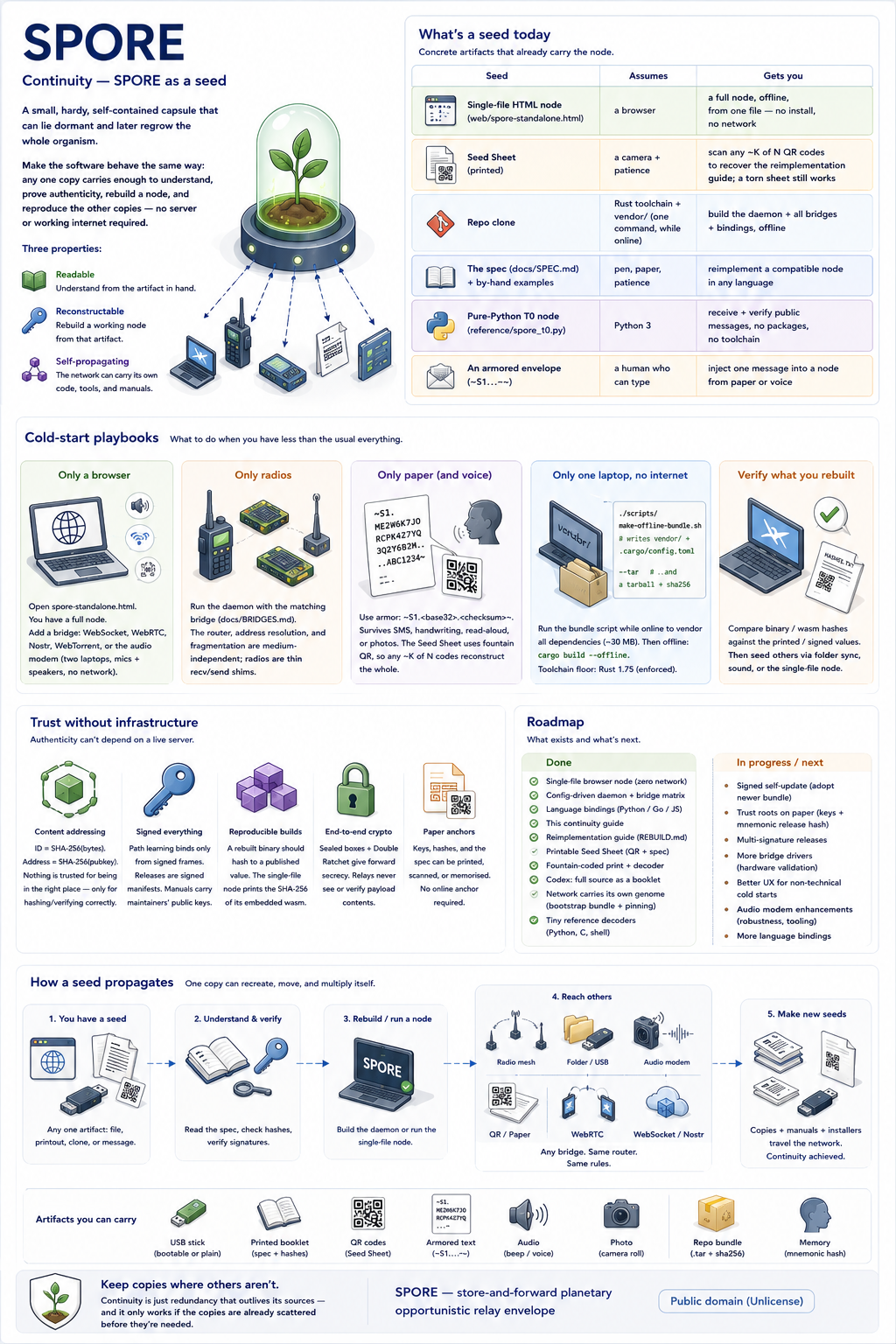
Poster summary, for a quick visual overview — full size. The text on this page is the living source; the poster can lag it.
The pieces of "outlives us"
| Piece | Answers | Lives at |
|---|---|---|
| Continuity | If I lose this device, this app, this website — does my node come back? | This page |
| Rebuild | If this codebase disappeared, could someone who has never seen it write a compatible node? | Rebuild guide |
| Reference decoders | Can I check a real envelope against something I need not trust — no crypto library, no dependency? | reference/ |
| Release artifacts | Can I get a working node and the means to rebuild it from one download, with no live infrastructure? | Every release carries spore-standalone.html and spore-offline-bundle.tar.gz beside the APK — Apps |
| The frozen contract | Will a node built from any of the above still speak to one built today? | tests/api_freeze.rs + reference/vectors.json, held by Contributing's freeze rules |
| Public domain | Is there a license, company or maintainer this depends on outliving? | LICENSE — no |
A surviving copy — a phone, a saved HTML file, a printed Seed Sheet, a clone, a release tarball — carries everything needed to keep working, verify it is genuine, and regrow the rest.
Three properties
Readable · Reconstructable · Self-propagating. Most software assumes a registry, CDN, or app store. SPORE's job is moving messages when that infrastructure is degraded — so getting SPORE must not depend on it. Understanding, verifying, and rebuilding travel with the node: dependency-light core, a spec independent of Rust, paper-friendly formats, and the network able to carry its own installer.
What's a seed today
| Seed | Assumes | Gets you |
|---|---|---|
| Single-file HTML | a browser | full node offline, zero network |
| Seed Sheet | camera + patience | any ~23 of 39 QR → reimplementation guide |
| Offline bundle | Rust toolchain | daemon + bridges, cargo build --offline immediately — every release carries the source with dependencies pre-vendored, or run make-offline-bundle.sh on a clone yourself |
| SPEC + by-hand examples | pen, paper | reimplement in any language |
| Pure-Python T0 | Python 3 | receive + verify public mail, no packages |
| Armored envelope | typing | inject one message from paper or voice |
Links and build commands: Apps & daemons and the Dev guide's "Install & verify a release."
Cold-start playbooks
Only a browser. Open spore-standalone.html. Add a bridge from the page
(WebSocket, WebRTC, Nostr, WebTorrent) or the audio modem so two laptops
pair with no network. Get the file from Apps.
Only radios. Daemon + matching bridge (Bridges). Router and fragmentation are medium-independent; the radio is a thin send/recv shim.
Only paper (and voice). Armor form ~S1.<base32>.<checksum>~ survives
SMS, handwriting, or a read-aloud. Seed Sheet fountain QR recovers bulk guides
from a partial print.
Only one laptop, no internet. Simplest: grab spore-offline-bundle.tar.gz
from any release before you go
offline — every one carries this source tree with dependencies already
vendored in, so cargo build --offline works the moment you unpack it. No
release artifact handy? Clone + vendor it yourself while still online:
./scripts/make-offline-bundle.sh
./scripts/make-offline-bundle.sh --tar
MSRV is enforced by CI (see Cargo.toml / security findings for the floor).
Cargo.lock pins versions; vendor/ carries the sources. HTML node, printed
spec, and Seed Sheet need no vendor step.
Trust without infrastructure
Hash is identity. Signatures bind path learning. Seed ≠ full inbox backup.
- Content addressing — envelope ID is the hash of its bytes; node address is the hash of its key.
- Signed everything — path learning from signed frames; releases as signed manifests.
- Seed restores identity, not the prekey ring — carrying the ring keeps old sealed mail readable and lengthens the theft window. Continuity of identity and forward secrecy of content pull opposite ways; you choose.
- Reproducible builds — compare hashes offline; the single-file node prints the wasm SHA-256 in its footer.
Roadmap
What exists and what's next:
- Single-file browser node — zero network, CI-checked
- Config-driven daemon + bridge matrix
- Language bindings — Python / Go / JS from one C ABI
- This continuity guide with cold-start playbooks
- Reimplementation guide (Rebuild)
- Printable Seed Sheet + fountain-coded QR
- Tiny reference decoders (Python, C, shell)
- [◑] Network carries its own genome — bootstrap bundle on a well-known topic; still open: signed self-update of the binary
- Codex — full source as hash-stamped booklet
- Trust roots on paper — multi-signature release anchors
Help re-seed
Keep a copy somewhere the others aren't: offline disk, phone HTML, printed sheet, another host. Continuity is redundancy that outlives its sources — and it only works if the copies are already scattered before they're needed.